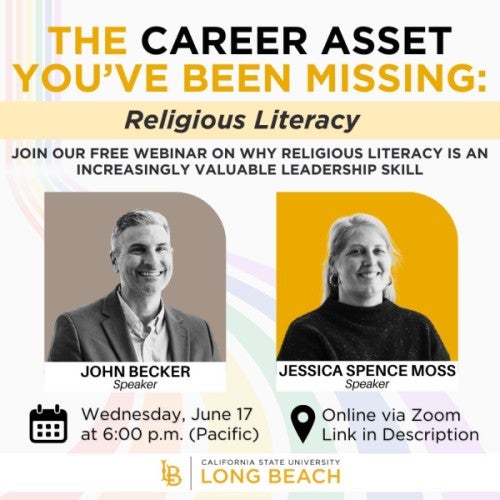
In today’s interconnected world, it’s more vital than ever to develop the ability to understand and empathize with diverse religions, cultures, and values. The Interfaith Studies certificate program offers a dynamic exploration of global religious traditions through dialogue, empathy, and shared humanity. Graduates learn to promote cultural literacy and respectful engagement in both personal and professional contexts.
Learn valuable skills for personal & professional growth!
Fully online
Two 8-week courses
Complete both courses to earn a certificate

This fully online, two-course certificate program is designed for working professionals and lifelong learners who want to deepen their cultural awareness and strengthen their ability to lead in diverse settings. The curriculum applies interfaith theory to real-world situations to gain an understanding of how religious and secular belief systems shape communication, decision-making, and social dynamics. Two 8-week courses can be taken independently or simultaneously, with approximately 30 hours of total instruction for each course. Students earn a digital badge for each course and the full certificate after completing both.
Through a multidisciplinary approach, the program examines the core teachings, rituals, and worldviews of major religions while addressing pressing contemporary issues such as religious pluralism, interfaith cooperation, and social justice. Participants will engage with guest speakers, case studies, and collaborative discussions that highlight how interfaith understanding can serve as a powerful tool for leadership, peacebuilding, and community resilience — especially in the pluralistic region of Southern California.For those working in education, healthcare, public service, or global affairs, this program provides a strong foundation in skills that foster equity, inclusion, and connection.

Cultural Literacy: Gain a deeper understanding of major world religions and belief systems, enhancing your ability to navigate diverse cultural and spiritual contexts.
Dialogue & Empathy: Develop respectful communication and active listening skills through interfaith dialogue that fosters empathy and mutual understanding.
Real-World Relevance: Apply interfaith principles to contemporary issues in education, healthcare, public service, and community leadership.
Professional Development: Earn a certificate and digital badge to showcase your interfaith literacy and cultural competence on resumes and professional platforms.
Personal Growth: Explore your own values while learning to appreciate the beliefs of others, broadening your worldview and deepening your sense of shared humanity.
Those that are religiously or spiritually curious and want to understand different world views.
HR managers interested in working with religiously diverse employees
K-12 teachers, healthcare workers, first responders, city personnel, and others who work with diverse populations
Foster interfaith literacy and cultural competency
Promote respectful dialogue across religious and secular worldviews
Strengthen university-community partnerships through engagement with local interfaith organizations
Equip participants with practical skills for navigating religious diversity in professional settings
Explore the worldviews, values, and ethics—not just religious beliefs—that shape communication, decision-making, and community dynamics.
Build the skills to engage with religion and spirituality as complex, real-world factors that influence personal identity, professional environments, and societal structures.
Develop empathy and cultural awareness to navigate conversations that may be challenging, but are essential to equity and inclusion.
Program Outline
The InterfaithStudies certificateprogramincludestwo foundational courses that integrate theory and practice to prepare students for meaningful civic and interfaithengagement. Designed for a diverse student body and a surrounding community rich in interfaith initiatives, the program meets growing academic and societal demand for collaborative, multicultural education.
This introductory course provides a theoretical foundation exploring the motivations and frameworks that inspire collaboration across diverse faith traditions. The course will encourage students to reflect on their own faith traditions while learning to appreciate and understand others, fostering a mindset of mutual respect and curiosity.
Key topics include:
Historical and contemporary impetuses for interfaith dialogue
Paradigms and models developed by prominent interfaith leaders
Critical engagement with theological, philosophical, and ethical perspectives that support interfaith cooperation.
Building on the theoretical groundwork laid in the first course, this second course will focus on the practical application of interfaith collaboration. This course emphasizes experiential learning and civic engagement, encouraging students to become agents of positive change through interfaith action.
Key topics include:
Case studies highlighting successful interfaith initiatives, particularly in conflict resolution and community building
Hands-on service-learning component involving active engagement with diverse faith communities in the Long Beach area
Relationship-building with local religious organizations to foster long-term partnerships and community impact
Instructors
Dr. John Becker is a lecturer in Religious Studies at CSULB, specializing in interfaith dialogue, contemporary theology, and the intersection of religion and ecology. He holds a Ph.D. in Comparative Theology and Philosophy from Claremont School of Theology and is a Research Fellow at the Institute for Postmodern Development of China. Dr. Becker is also the co-editor of Process Thought and Roman Catholicism and serves as the department’s Graduate Adviser.
John Becker, Lecturer Faculty
Dr. Jessica Spence Moss is an interfaith scholar and activist dedicated to building just and inclusive communities. She earned her PhD in Cultural Studies from Claremont Graduate University in 2023, where her research on interfaith communities was supported by an AAUW American Fellowship and a CGU Transdisciplinary Studies grant. Since 2012, she has worked closely with the Orange County Interfaith Network and local councils, served as Assistant Director of Interfaith Programs at CSULB (2024–25), supports interfaith initiatives at USC, and has been Executive Director of the Interfaith Youth Alliance since 2021. Grounded in curiosity, hospitality, and authenticity, Jessica remains inspired by the beauty and ethical wisdom found across diverse religious and spiritual traditions.
Jessica Spence Moss, Lecturer
Frequently Asked Questions
This course is open to students, professionals, and community members from all backgrounds — no prior religious studies experience is required. It’s ideal for those in education, public service, healthcare, nonprofit work, or anyone interested in cultural literacy.
The course explores a range of traditions including (but not limited to) Christianity, Islam, Judaism, Buddhism, Hinduism, Sikhism, Indigenous spiritualities, and secular worldviews. Emphasis is placed on both common values and unique perspectives.
The Interfaith Studies certificate program is delivered fully online and primarily asynchronous, allowing you to complete coursework on your own schedule. The program consists of two 8-week courses, taken at the same time. Each course includes approximately 30 hours of total instruction, with an expected 2-3 hours of work per week.
No, not at all. The course welcomes participants of all faiths as well as those with no particular faith. It’s designed to be inclusive, respectful, and exploratory — not prescriptive or evangelistic.
Assignments may include reflective writing assignments, group discussions, case studies, and a final project that applies interfaith principles to a real-world issue or community initiative.
You’ll gain practical, transferable skills that help you navigate religious and cultural diversity in both personal and professional settings. These skills include:
Cultural literacy across a range of religious and secular worldviews
Empathetic communication and active listening
Inclusive leadership and conflict resolution strategies
Critical thinking around ethics, values, and belief systems
Real-world application of interfaith principles in your workplace or community
Upon successful completion of the program, participants will receive a certificate of completion along with a digital badge for each course that can be shared on LinkedIn or included in resumes.
Each course — Theoretical Frameworks for Interfaith Engagement and Religious Pluralism and An Interfaith Call to Action: Practices Towards the Common Good— can be taken independently and in any order. However, to earn the Interfaith Studies Certificate, participants must complete both courses successfully. There is no degree associated with this program.
No, we do not provide job placement. However, jobs may be shared with students on Canvas, our online learning management system, as well as via social media channels such as LinkedIn.
Theoretical Frameworks for Interfaith Engagement and Religious Pluralism
This introductory course provides a theoretical foundation exploring the motivations and frameworks that inspire collaboration across diverse faith traditions, including secular perspectives. The course will encourage students to reflect on their own worldviews while learning to appreciate and understand others, fostering a mindset of mutual respect and curiosity.
Key topics include:
Historical and contemporary impetuses for interfaith dialogue
Paradigms and models developed by prominent interfaith leaders
Critical engagement with theological, philosophical, and ethical perspectives that support interfaith cooperation.
Class Schedule for Section Number CPIE378.(2262-1)
Date
Time
Day
Meeting Type
Location
Mar 30, '26
12:00PM - 12:01PM
Monday
Lecture
Virtual Classroom, Online
CSULB Online
Jul 24, '26
12:00PM - 12:01PM
Friday
Lecture
Virtual Classroom, Online
CSULB Online
Interfaith Leadership in Practice
Building on the theoretical groundwork laid in the first course, this second course will focus on the practical application of interfaith collaboration. This course emphasizes experiential learning and civic engagement, encouraging students to become agents of positive change through interfaith action.
Key topics include:
Case studies highlighting successful interfaith initiatives, particularly in conflict resolution and community building
Hands-on service-learning component involving active engagement with diverse faith communities in the Long Beach area
Relationship-building with local religious organizations to foster long-term partnerships and community impact